
Stop Saving Your Customer's Money Without Asking
Why deciding what's 'too expensive' for your buyer destroys trust and revenue—and how to offer the full range instead.
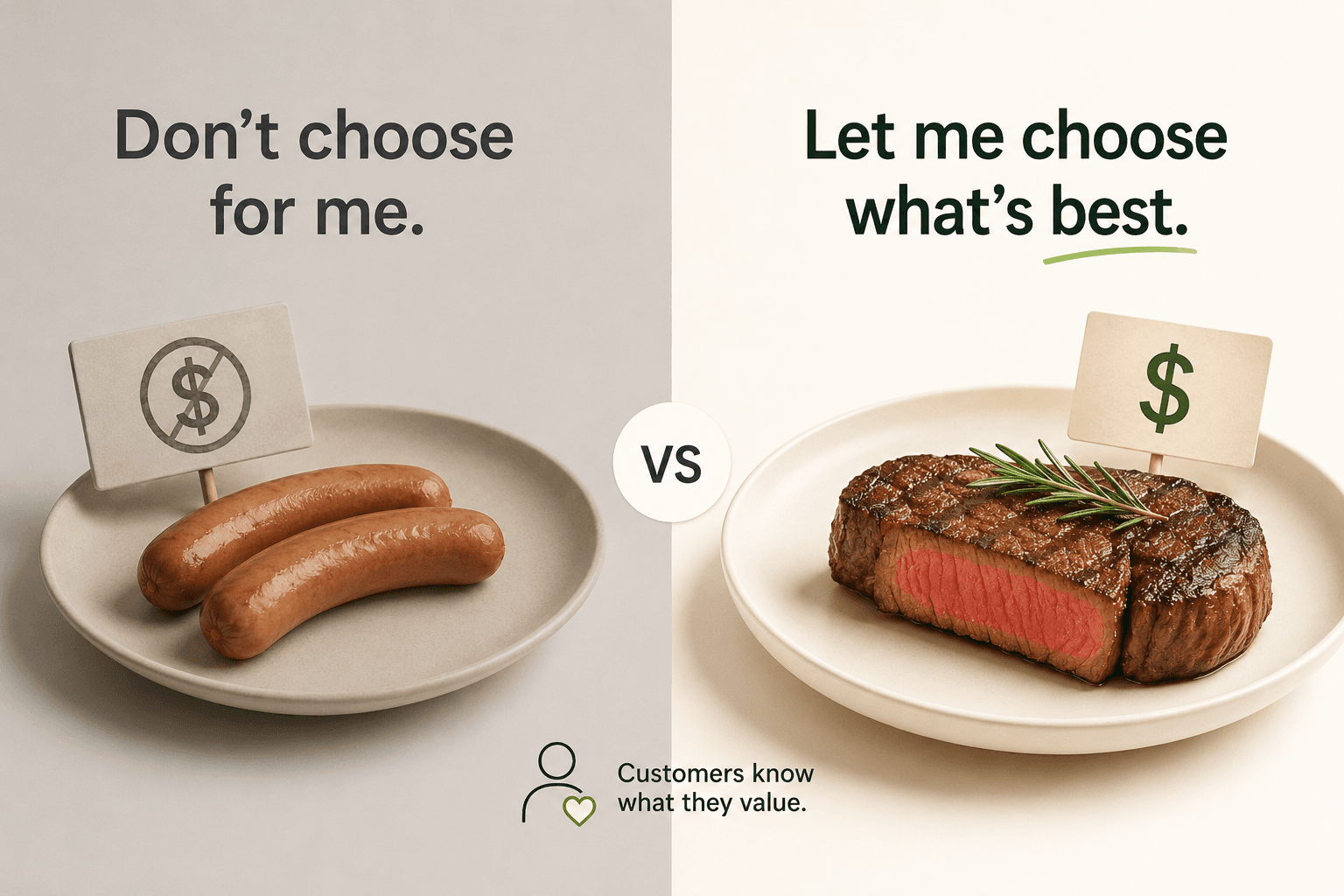
You know the feeling. You ask for a solution, and someone hands you a menu of mediocre options. Later you discover a premium tier that would have solved everything—but they never showed it because they decided it was "too expensive" for you.
💡 When you silently filter out higher-priced options, you're not being helpful—you're robbing your customer of choice and yourself of revenue.
Why "Saving" Your Customer's Money Backfires
It feels considerate to avoid recommending the pricier option. But research and real-world stories show this almost always backfires.
💡 Trying to economize someone else's money often makes them invest more of their own time and cash later.
The "Steak vs. Sausages" Problem
Your customer asks for dinner. You decide steak is "unnecessary" and offer sausages. Maybe they accept. But they'll resent you for it.
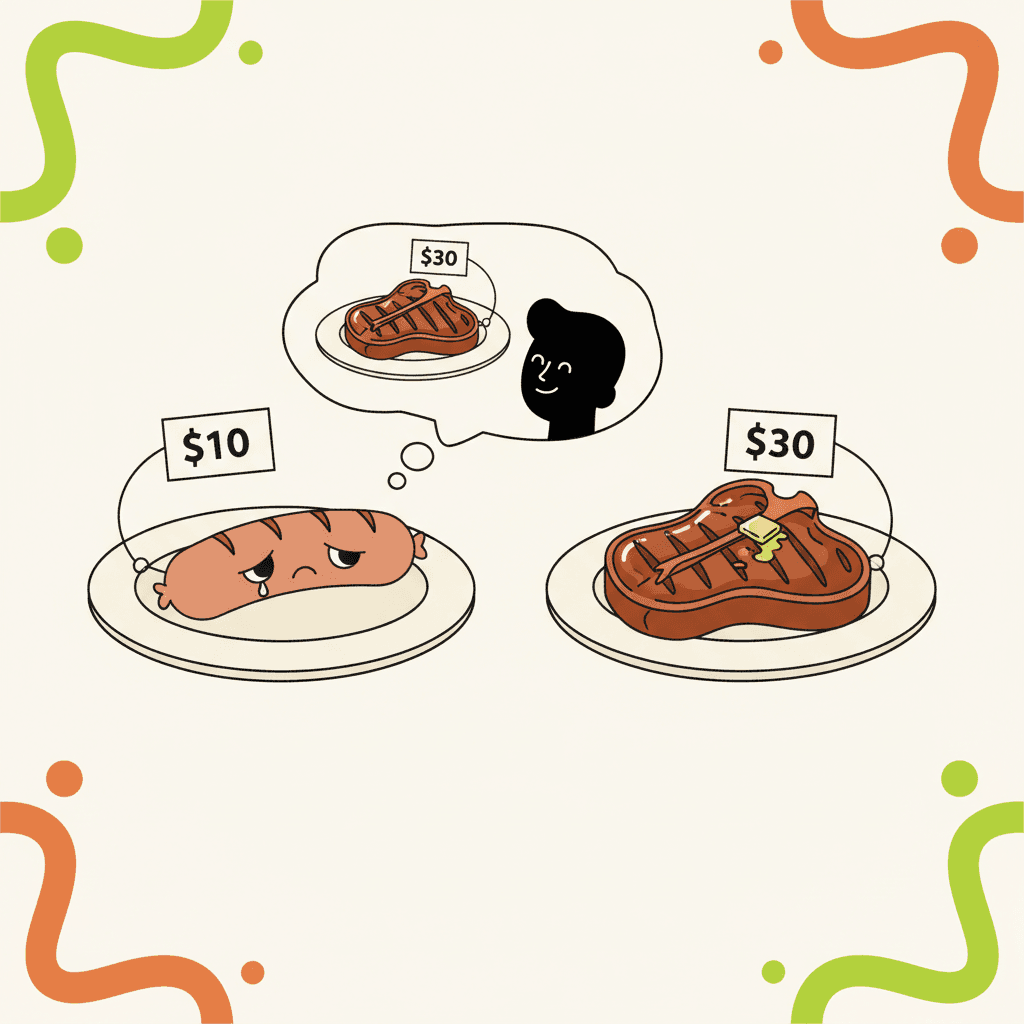
A flat illustration showing two plates: one with a sad sausage, the other with a juicy steak. A price tag on t
Three Ways This Hurts Your Business
1. You Shrink Your Revenue Ceiling
If you never offer premium tiers, you never capture customers willing to pay more. Many shoppers actively seek quality and will pay a premium for it.[1][10]
2. You Misread Demand
When you assume "no one needs the expensive version," you stop selling—or even developing—it. But premium demand is real. You just don't see it because you never present the option.[10]
3. You Erode Trust
Customers notice when you hide better solutions. They feel manipulated and disrespected. Trust takes years to build and seconds to lose.
How to Fix It: A 4-Step Framework
Step 1: Always Show the Full Range
Use a good-better-best tier structure. Present all options neutrally. Let the customer decide what fits their priorities.
Step 2: Ask About Constraints—Don't Assume Them
Train yourself and your team to ask discovery questions:
Only after hearing explicit constraints should you recommend—and even then, mention the premium option as context.
Step 3: Separate Your Personal Anchors from Professional Behavior
Your own beliefs about what's "too expensive" don't apply to your customers. If you personally think $50 for a candle is crazy, that doesn't mean your buyer feels the same.
Step 4: Make Value vs. Price Trade-Offs Explicit
Help customers see total cost of ownership, not just upfront price.

A flat illustration comparing two paths: one cheap path with many detours and repair signs, ending at a high t
Real Stories: When "Saving" Backfired
A popular compilation of 20+ real cases shows that economizing on health, safety, or reliability leads to larger costs later.[12] Another detailed account explains how attempts to save someone else's money consistently resulted in inefficiency and higher overall spending.[11]
FAQ
Should I ever recommend the cheaper option?
Yes—but only after the customer explicitly says budget is their top priority. Never assume it. Offer the full range first, then let them choose.
What if my customers actually do have tight budgets?
That's fine. They'll choose the lower tier. But don't pre-filter for them. Many customers with tight budgets for one purchase may be willing to pay more for another—or may upgrade later.
How do I train my team to stop "saving" customers' money?
Use scripts that focus on value and fit. Role-play scenarios where the seller must present all three tiers without judgment. Remind them: "Your job is to inform, not to decide for the customer."
The Bottom Line
Never economize on your customer's behalf. Don't decide what's "too expensive." Show the full range, explain the value, and let them choose.
💡 Customers are often willing—even eager—to pay more for better quality, convenience, and experience. Hiding premium options is a pricing and trust mistake.
Ready to apply this to your Etsy shop? Try MakeBox AI free and start optimizing your listings for every price tier.
Learn more about Etsy SEO tools and Etsy automation to grow your shop.
Want to talk through your setup?
Get in touch and I'll walk through what would actually move the needle for your shop or business.