⬡ MakeBox
The seller's field guide / 01

A better Etsy title starts with clarity.

Learn how to name your product, choose useful details, and write for the person behind the search.

Etsy SEO · 12 min read · Reviewed November 6, 2026

Bring your product facts. Review every suggestion.

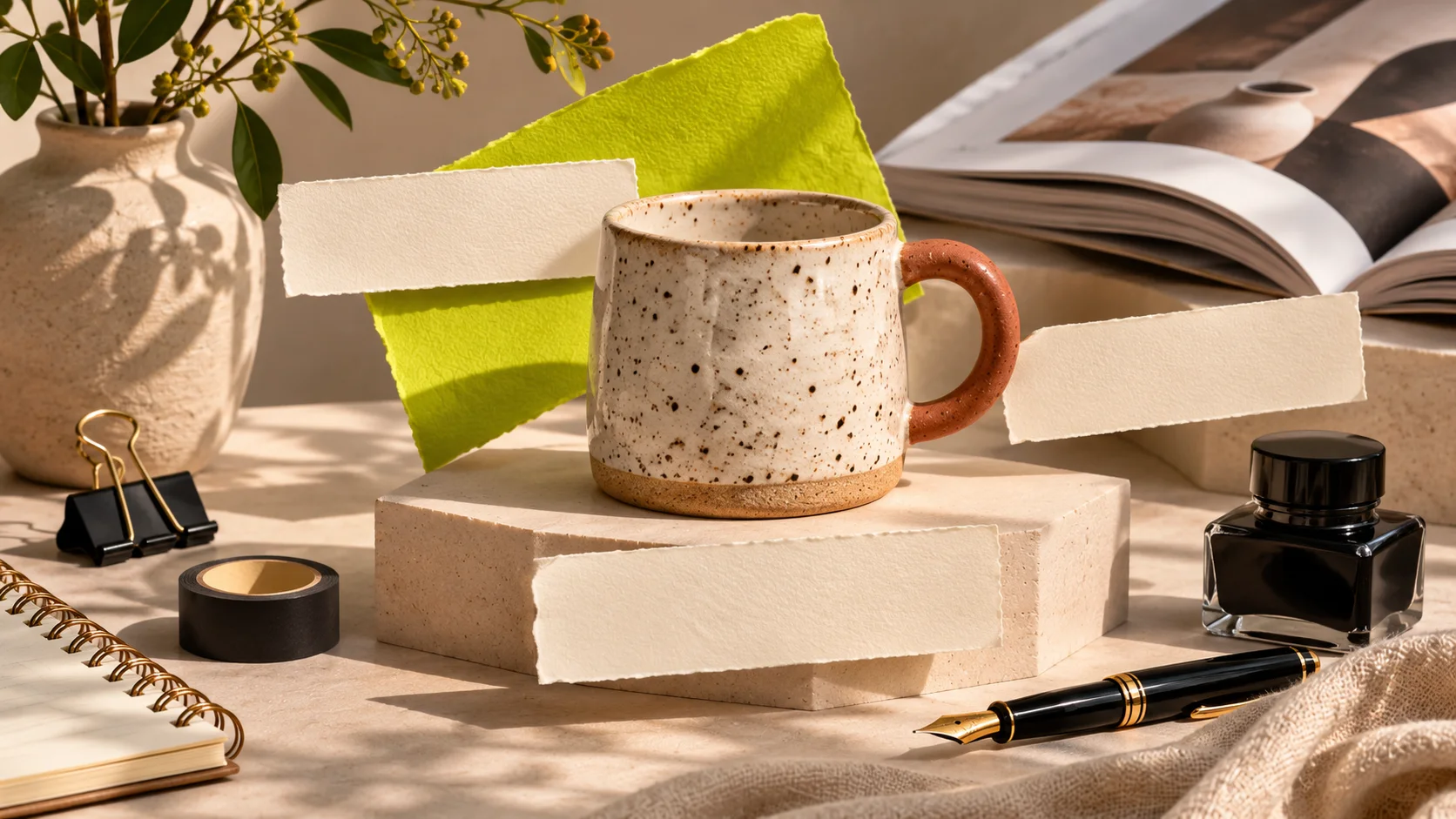
Conceptual still life of a speckled ceramic mug, paper labels and writing toolsOne product.
One clear story. ↗

AI-generated editorial illustration. Product and examples are fictional.

A good title in one sentence

Tell shoppers what they are looking at.

Imagine someone scrolling past a small product photo. Your title should quickly answer: What is it? What makes this version distinct?

A clear title is useful to shoppers and relevant to search. It does not need to carry every possible keyword. Etsy looks at the listing as a whole, including tags, attributes, descriptions, the first photo and other signals. A title change alone cannot guarantee visibility or sales.

This guide uses Etsy’s current title guidance, checked November 6, 2026. The examples are illustrative, not tested listing results.

140

characters maximum in an Etsy listing title.

<15

words is Etsy’s suggested consideration, not a hard requirement.

01

clear product: say what the item is once.

A small formula, not a ranking trick

Item + defining details + useful specifics.

There is no mandatory title template. Start here, then keep the details a buyer needs to distinguish your item.

01 / THE ITEM

What is it?

Mug, planner, ring, T-shirt. Use the name a buyer would understand.

02 / THE TRAITS

What makes it different?

Choose relevant facts such as material, color, size or personalization.

03 / THE EDIT

Can it breathe?

Remove repeated words, subjective claims and details better placed elsewhere.

Before / after · fictional example

From a keyword pile
to a clear product.

BEFORE / HARD TO SCANPersonalized Mug Coffee Mug Ceramic Mug Gift Cup Custom Mug for Everyone
AFTER / CLEARERPersonalized Speckled Ceramic Mug with Custom Name

The second example is only appropriate if the item is actually ceramic, speckled, and customizable with a name. It is an editorial example, not proof of improved search performance.

The method

Five steps to your own title.

01. Start with the product.

Write the item’s everyday name. A buyer should know whether the listing is a physical mug, a digital file, or something else.

02. Pick the facts that matter.

Use the most useful objective traits: material, color, size, personalization, or another defining detail. Include only what is true.

03. Research the buyer’s language.

Try relevant phrases in Etsy search and review your Shop Stats. Marketplace Insights provides Etsy search data and related terms. A suggestion is a starting point, not proof that it fits your product.

04. Remove the extra noise.

Avoid repeating the item name, stacking gift recipients, or adding “free shipping,” “sale,” and subjective words such as “perfect.” Include a holiday or occasion only when it is essential to the item.

05. Read it like a shopper.

Is it accurate, natural and easy to scan? Keep it within 140 characters. Etsy suggests considering fewer than 15 words; use the space you need for meaningful details.

YOUR LISTING, YOUR CALL

Want help writing your title?

MakeBox AI can prepare suggestions using your product details. Review and edit them before deciding what to apply.

AI work uses your available allowance. Check the shown cost before you start.

The research desk / a practical walkthrough

Find the words.
Then make a decision.

A phrase is useful only if it fits the item you actually sell. Start with the product, investigate how shoppers describe it, and keep a short record of why you chose a title.

01 / START WITH FACTS

Write a product fact sheet

Before you open a keyword tool, write down the item, material, size or format, defining style, and what the buyer receives. Mark uncertain details as questions. For a digital download, note the file type and whether the buyer receives a file rather than a shipped object.

Example: a ceramic mug with a speckled glaze and an optional custom name. Only use these words if they are true for your actual listing.

02 / BUILD A SHORT LIST

Describe it in buyer language

Brainstorm a few natural phrases: the item name, a relevant material, and a meaningful customization. Look at Etsy search suggestions for ideas and your own Shop Stats for terms that have already brought visits. Suggestions are ideas, not a guarantee of demand, relevance, or future sales.

Working list: ceramic mug · speckled mug · personalized mug · custom name mug. These are invented examples, not verified search-volume data.

03 / CHECK THE EVIDENCE

Open Marketplace Insights

In Etsy’s web Shop Manager, go to Stats → Marketplace Insights. Search a relevant phrase and compare the available searches, listings and related terms. Etsy currently offers up to 15 free searches per week; saved results from those searches remain available for seven days. Availability and limits can change.

Think of search counts and listing counts as context. They do not tell you that your item will rank, sell, or make a particular profit. Review relevance and listing quality alongside the numbers.

04 / CHOOSE & EDIT

Keep the buyer’s decision in mind

Choose the clearest item name and the characteristics that distinguish this item. Then read the title aloud. If a word only repeats another word, does not describe the item, or requires an unsupported assumption, remove it.

Compare two readable versions with a colleague or customer if you can. Neither one becomes a proven winner until you evaluate it in the context of your shop.
Source: Etsy Marketplace Insights and Etsy Stats. Checked November 6, 2026.

A working example / editorial illustration

Turn a product brief
into a useful title.

Here is a complete thought process. The product is fictional, and the words below are not presented as measured keywords.

FACT SHEETTHE TITLE DECISION
What is it?

A ceramic mug.

Name the item clearly.

“Ceramic mug” tells a shopper what they are looking at.

What is distinctive?

Speckled finish and custom name.

Choose facts that help.

“Speckled” and “custom name” distinguish this version, if accurate.

What else is true?

Imagine capacity and care details were supplied by the seller.

Decide what belongs elsewhere.

Put applicable specifications in attributes and the description if the title reads more clearly without them.

ONE POSSIBLE TITLE · NOT A RANKING CLAIMPersonalized Speckled Ceramic Mug with Custom Name

If customization is optional, make that clear in the listing options and description. If a material, finish, capacity or personalization is unknown, ask the seller instead of inferring it from the image.

Different listing, different choices

Ask the next
useful question.

Physical item: what arrives?

Name the object and any material, finish, quantity or size that helps a buyer distinguish it. Do not imply a handmade process or material you cannot confirm.

Digital item: what will be downloaded?

Make the file format and digital nature unmistakable. A “printable wall art PDF” is different from a framed print. Verify the file details and describe what the buyer receives in the listing.

Personalized item: what changes?

State the customization when it is a defining feature, and explain the buyer’s choices in the personalization field. Do not promise a customization you cannot fulfill.

Vintage: can the claim be supported?

Use accurate item details and verify the listing meets Etsy’s current vintage eligibility requirements. If the date or material is uncertain, research it before making a claim.

Try it yourself / stays in your browser

Give your title
a little breathing room.

Paste or type a draft below. The counter is a writing aid, not an SEO score or a promise of results.

0 / 140 characters0 words

Character count is an approximation for some emoji or combined characters; Etsy’s own editor is the final authority. Nothing is saved or sent by this tool.

Where should the other words go?

Your title is
one part of the listing.

Use relevant tags, specific categories and available attributes alongside an accurate description. Etsy says search considers the whole listing; keep information consistent across it.

TAGS

Broaden relevant phrases.

Etsy recommends using all 13 available tags and varying relevant phrases.

ATTRIBUTES

Fill what applies.

Choose accurate category and attribute options for your actual item.

PHOTOS + DESCRIPTION

Show and explain.

Use clear images and give the buyer details that help them decide.

More fictional examples

Different products.
Same principle.

Physical product

Handmade Linen Apron in Olive Green

Names the item and its material and color. Use “handmade” only if accurate and consistent with Etsy’s policies.

Digital product

Printable Weekly Meal Planner, Undated PDF

Names the item and format. Make the digital nature clear in the photos and description too.

Personalized product

Personalized Oak Dog Leash Holder with Name

States the item, material and personalization. Check every claim against the actual product.

Vintage item

Vintage Brass Candle Holder, Pair of Two

Explains the item, material and quantity; use vintage only when the item meets Etsy’s requirements.

These are invented teaching examples. They are not keyword-volume claims or endorsements of specific products.

After you update

Change thoughtfully.
Then observe.

If an existing listing already receives traffic or sales, record its baseline before making a change. Try a small, deliberate edit and compare a similar period in Etsy Shop Stats; note the dates and any other changes.

Seasonality, ads, photos, price, competition and many other factors can affect the outcome. A before-and-after comparison cannot by itself prove that the title caused a change. Avoid changing many things at once if your goal is to learn from the result.

A small experiment / no special tool required

Measure what changed.
Keep your notes.

Use this as a disciplined observation, not an Etsy-endorsed ranking formula or a controlled causal test.

01 / PICK

Choose one relevant listing. If it is a bestseller, consider starting with a less critical item; avoid unnecessary changes when the downside matters to your business.

02 / RECORD

Record the original title, the date, the selected time window, traffic sources, views, favorites and orders that Etsy shows. Keep ad, price, photo, stock and seasonal notes separately.

03 / CHANGE

Make one intentional title edit. Check factual accuracy, relevant attributes and tags; do not change unrelated details simply to make a comparison look better.

04 / REVIEW

Compare similar periods in Shop Manager → Stats. Look at Etsy search separately from ads and other traffic. With few visits or orders, results are noisy; avoid conclusions from a single sale or a few days.

Views ≠ visits. Etsy describes views as listing views; visits represent people looking at your shop or listings. One person viewing several listings can create multiple views within one visit. Check the definition and scope of each metric before comparing it.

Search results are personalized, so looking for your own item is not a dependable ranking measurement. Etsy Stats is a better place to inspect your own traffic. Seasonal shifts, ads, competition and shopper behavior still make before/after results inconclusive.

Save this / pre-publish checklist

A final check
before you save.

Tick the items that apply to your draft. The checklist stays on this page and resets when you reload.

Title checklist

A few quick answers

Questions sellers ask.

Do I have to use all 140 characters?

No. Etsy sets 140 characters as a maximum, not a target. Use the space needed to describe the item clearly.

Are fewer than 15 words required?

No. Etsy suggests considering fewer than 15 words; that is guidance, not a universal rule or a guarantee.

Should I repeat every keyword?

No. Etsy recommends avoiding repetition and writing for clarity. Use relevant tags and attributes to support the rest of the listing.

Will a new title get me to page one?

No one can guarantee that. Etsy search considers multiple signals and shopper context, and results can vary.

Your next small step

Make a clearer listing, one detail at a time.

Bring your product details or an existing listing to MakeBox. Review and edit every suggestion before you choose whether to apply it.

AI suggestions need fact-checking. See your allowance and the action cost in the app before starting.

Sources & editorial notes

Examples and hero image are illustrative. MakeBox is independent and is not endorsed by Etsy.